
AI is Transforming Social Media Marketing in 2026: Tools, Trends & Strategies
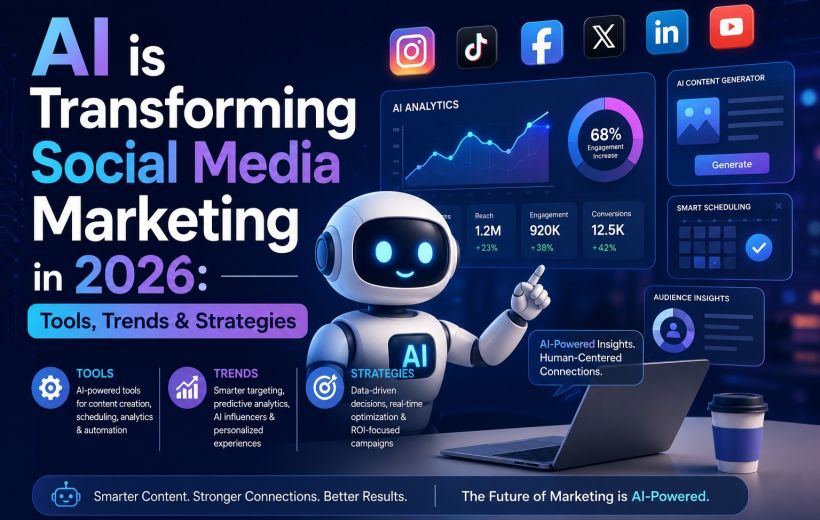
Scroll through any social feed today and you’ll notice something has shifted. The captions feel sharper, the videos are edited in seconds instead of hours, and brands seem to know exactly what you want to see before you even search for it. That’s not a coincidence — it’s AI in social media marketing quietly running in the background of almost every post, ad, and DM you interact with.
We’re now deep into 2026, and AI in social media marketing isn’t a “nice to have” anymore. It’s the operating layer underneath the entire industry. If you’re a marketer, business owner, or content creator wondering how to keep up, this guide breaks down exactly how AI is transforming social media marketing in 2026 — the tools driving it, the trends shaping it, and practical strategies you can actually use.
Why 2026 Feels Like a Turning Point for AI in Social Media Marketing
For years, AI in social media marketing meant a chatbot that could write a caption or suggest a hashtag. That era is over. Marketing teams have moved from using AI as an assistant to letting it run entire workflows — planning content calendars, generating platform-specific variations, publishing at optimal times, replying to comments, and adjusting strategy based on live performance data.
Industry surveys this year show that a large majority of social media managers, well over three-quarters, now use AI tools every single day, not occasionally. What used to take a five-person content team a full week can now be drafted, tested, and refined in an afternoon. That efficiency gap is exactly why understanding social media marketing trends 2026 has become essential reading for anyone managing a brand’s online presence — falling behind here isn’t a small disadvantage anymore, it’s a real competitive gap.
The Core Tools Driving AI in Social Media Marketing
1. AI Content Generators
Text, image, and video generation tools have matured to the point where a single idea — a product launch, a trending topic, a customer insight — can be turned into a dozen platform-native formats almost instantly. This is one of the clearest examples of AI in social media marketing at work: a blog idea becomes a TikTok script, a LinkedIn post, a Reel concept, and a Reddit discussion thread, each written to fit how that specific audience actually behaves.
2. Social Listening and Predictive Analytics
Instead of reviewing what worked after a campaign ends, brands now use AI-powered listening tools to catch shifts in conversation as they happen. These tools scan comments, mentions, and emerging hashtags in near real time, flagging opportunities or PR risks before a human would even notice the pattern forming. This predictive layer is quickly becoming one of the defining social media marketing trends 2026 has produced.
3. AI Agents for Account Management
This is arguably the biggest shift of the year, and it’s central to how AI is transforming social media marketing in 2026. AI agents are no longer limited to drafting posts — many are now managing entire accounts within guardrails set by human strategists. They decide what to post, when to post it, and how to respond to incoming engagement, freeing up marketers to focus on big-picture strategy rather than day-to-day execution.
4. Smart Ad Optimization
Paid social has become almost fully automated on the backend. Platforms increasingly ask advertisers for a budget and a goal, then handle targeting, creative rotation, and bid adjustments automatically using predictive signals pulled from cross-channel data — another quiet but powerful example of AI in social media marketing.
5. AI-Powered Customer Service on Social
DMs and comment sections are now a genuine customer service channel, and AI chatbots handle a growing share of that volume — answering FAQs, routing complaints, and even closing sales, all without a human typing a single reply.
Social Media Marketing Trends 2026: What’s Actually Changing
AI Content Has Gone Mainstream — But So Has AI Fatigue
Nearly every serious brand now uses AI somewhere in its content pipeline. But there’s a counter-trend running right alongside it: audiences are getting tired of content that feels too polished, too perfect, too obviously machine-made. A notable share of consumers say they’re less likely to engage with a brand once they realize its content is AI-generated without any disclosure. This tension is one of the most talked-about social media marketing trends 2026 has brought into the open.
This is pushing smart brands toward what you could call “engineered imperfection” — leaving in a small stumble, a casual tone, a behind-the-scenes clip that doesn’t look overly produced. The irony of AI in social media marketing right now is that it’s being used to look more human, not less.
Social Platforms Are Becoming Search Engines
A significant chunk of younger users now start their search journey on TikTok, Instagram, or YouTube instead of Google. This has given rise to “social SEO” — optimizing captions, video transcripts, and on-screen text the same way you’d optimize a webpage. Among the social media marketing trends 2026 has accelerated, this shift toward social-as-search may be the most disruptive for traditional marketing funnels.
Short-Form Video Still Dominates, But Storytelling Is the New Edge
Short videos remain the default content format across nearly every platform, but simply jumping on trending audio isn’t enough anymore. With AI making it trivially easy to produce high volumes of video, the brands that stand out are the ones investing in recognizable characters, ongoing storylines, and a distinct brand voice — things AI can assist with, but not replace.
Community Over Reach
As algorithmic feeds become more shaped by AI in social media marketing and content becomes more of a commodity, users are gravitating toward smaller, more personal spaces — niche groups, close communities, and creators with modest but highly engaged followings. Micro-influencers with a few thousand followers are often out-performing larger accounts on genuine engagement.
Agentic Marketing Is the Next Frontier
The newest development this year is “agenticAI” —systems that don’t just assist a marketer but operate semi-independently across an entire channel, adjusting strategy based on live results. Enterprise adoption of this approach is accelerating fast, with social media leading the way ahead of email and paid search. It’s a strong signal of where social media marketing trends 2026 are heading next.
Practical Strategies for Using AI in Social Media Marketing
1. Use AI for speed, not for identity.
Let AI handle first drafts, resizing, formatting, and A/B testing variations. But your brand voice, values, and the emotional core of your storytelling should still come from real people. This balance is what most marketers say is critical to keeping AI in social media marketing from feeling hollow.
2. Build a social listening habit, not just a reporting habit.
Set up AI listening tools to flag conversation shifts weekly, not quarterly. The brands winning attention among current social media marketing trends 2026 has highlighted are the ones reacting to culture in days, not months.
3. Disclose AI use where it matters.
Transparency isn’t just an ethical nicety anymore — it directly affects whether consumers trust and engage with your content. A simple, honest note that a visual was AI-assisted can prevent backlash later.
4. Optimize captions and transcripts for social search.
Treat every caption like a mini blog post. Include the terms your audience is actually typing into TikTok or Instagram’s search bar, not just clever wordplay.
5. Invest in one or two agentic tools rather than five disconnected apps.
Instead of stitching together separate tools for scheduling, content generation, and analytics, look for platforms that combine these functions. It reduces friction and keeps your data in one place, making your use of AI in social media marketing more accurate and efficient.
6. Keep humans in the loop for high-stakes decisions.
Let AI agents execute within clear guardrails, but reserve judgment calls — crisis response, sensitive topics, big creative bets — for real people. This single practice separates brands with a genuine strategy from brands that just look automated.
The Human Side Isn’t Going Anywhere
Here’s the paradox worth sitting with: the more AI takes over the mechanical parts of social media marketing — scheduling, resizing, first-draft writing, basic customer replies — the more valuable genuine human judgment becomes. Strategy, ethics, humor, empathy, and cultural nuance are still things audiences can sense, even when they can’t quite explain why one post feels real and another feels hollow.
Brands that treat AI in social media marketing as a creative partner, not a replacement for thought, are the ones actually winning attention this year. The rest are producing more content than ever and getting less out of it — proof that volume was never really the goal.
Frequently Asked Questions
Is AI in social media marketing replacing human marketers in 2026?
Not entirely. AI in social media marketing has taken over repetitive execution — scheduling, resizing, first drafts — but strategy, brand voice, and high-stakes decisions still need human judgment.
What are the biggest social media marketing trends 2026 has introduced?
The standout social media marketing trends 2026 has brought include agentic AI account management, social platforms functioning as search engines, community-first engagement over raw reach, and a growing consumer preference for visibly human, less “perfect” content.
How is AI transforming social media marketing in 2026 for small businesses?
Small businesses are seeing the biggest relative gains from how AI is transforming social media marketing in 2026, since AI tools let a single person or small team produce content, run ads, and manage customer replies at a scale that once required a full agency.
Final Thoughts
How AI is transforming social media marketing in 2026 ultimately comes down to this: AI has become the infrastructure, but people are still the reason anyone stops scrolling. The tools will keep getting faster and more autonomous, and the smartest marketers won’t resist that shift — they’ll use AI in social media marketing to buy back time for the work that actually needs a human touch: storytelling, strategy, and genuine connection.
If you’re building your social media marketing trends 2026 playbook, don’t ask “should we use AI?” That question is already answered. Ask instead: “where does AI in social media marketing free us up to be more human, not less?” That’s the question shaping every brand that’s actually winning attention this year — and it’s the clearest answer to how AI is transforming social media marketing in 2026.