
How AI Overviews Are Changing SEO in 2026: The Reality Most SEO Advice Won't Tell You
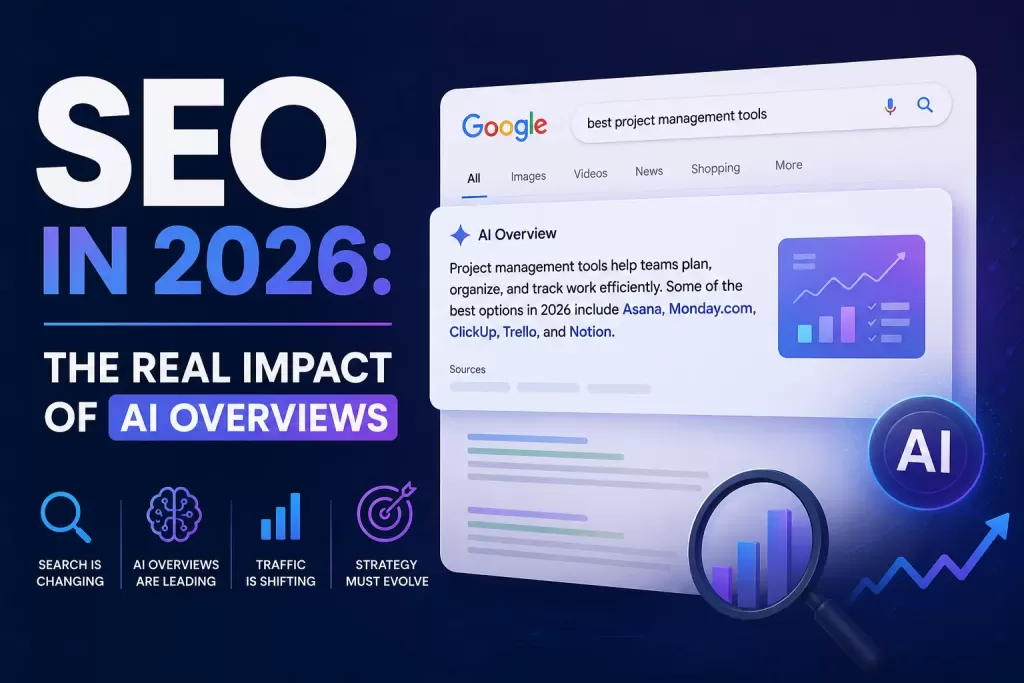
Google’s AI Overviews have fundamentally changed how search works. The traditional SEO playbook—publish content, rank on page one, and collect clicks—is no longer as reliable as it was a few years ago.
Many SEO discussions frame AI Overviews as either a disaster or an opportunity. The reality is more nuanced. AI Overviews are reducing visibility for some websites, increasing competition for others, and forcing businesses to rethink what organic traffic actually means.
If you’re still optimizing solely for rankings, you’re already behind.
What Are AI Overviews?
AI Overviews are Google’s AI-generated answers that appear above traditional search results for many informational queries. Instead of presenting users with a list of links, Google attempts to answer the question directly while citing selected sources.
For users, this often means fewer clicks.
For publishers, it means competing not only against other websites but also against Google’s own AI-generated response.
The key shift is simple:
Google is increasingly trying to solve the user’s problem before they visit your website.
The Hard Truth: Rankings No Longer Guarantee Traffic
For years, SEO professionals focused on ranking in the top three organic positions.
That strategy worked because higher rankings typically generated more clicks.
AI Overviews change that equation.
A page can rank first and still receive fewer clicks if Google answers the user’s question directly in the search results.
This is especially noticeable for:
- Definitions
- Basic how-to queries
- Informational questions
- Comparison searches
- Beginner-level educational content
The assumption that “higher rankings equal more traffic” is becoming less reliable.
Traffic is no longer the only metric that matters.
The Biggest SEO Losers
Not every website is affected equally.
The sites facing the greatest challenges are those producing content that is:
- Generic
- Easily summarized
- Written without unique expertise
- Based entirely on existing information
- Created primarily to target keywords
Many affiliate websites, niche content farms, and AI-generated content networks fall into this category.
If your article can be summarized into three paragraphs by an AI model without losing value, Google may have little reason to send users to your site.
That is the uncomfortable reality many publishers are now facing.
The Biggest SEO Winners
Despite the disruption, some websites are benefiting.
These include businesses and publishers that provide:
- Original research
- Industry expertise
- Real-world experience
- Proprietary data
- Unique insights
- Strong brand authority
AI systems still need reliable sources.
The websites most likely to be cited are those that demonstrate credibility and provide information that cannot be easily replicated.
The future belongs less to content volume and more to information quality.
Why E-E-A-T Matters More Than Ever
Google’s emphasis on Experience, Expertise, Authoritativeness, and Trustworthiness (E-E-A-T) is not new.
However, AI search has increased its importance.
When Google generates answers, it must determine which sources are trustworthy enough to cite.
This creates a competitive advantage for websites that demonstrate:
- Real authorship
- Professional credentials
- Industry experience
- Transparent business information
- Consistent publishing standards
Anonymous websites publishing hundreds of generic articles face a much harder path forward.
AI Content Is Not the Problem
One of the most persistent myths in SEO is that Google penalizes AI-generated content.
That is not Google’s primary concern.
The real issue is low-value content at scale.
Many publishers misunderstand this distinction.
Google does not care whether content was written by a human, AI, or both.
Google cares whether the content:
- Helps users
- Demonstrates expertise
- Provides original value
- Satisfies search intent
A poorly written human article is not automatically better than a high-quality AI-assisted article.
Likewise, thousands of AI-generated pages with no added expertise remain a risky strategy.
The New SEO Objective: Become a Citation Source
Traditional SEO focused on winning clicks.
Modern SEO increasingly focuses on becoming a source that AI systems trust.
This changes how content should be created.
Instead of publishing generic articles, focus on:
- Original case studies
- Survey data
- Industry reports
- Expert opinions
- First-hand experiences
- Detailed process documentation
When AI systems need evidence, examples, or expertise, these assets become significantly more valuable than recycled content.
Why Brand Building Is Becoming an SEO Strategy
Google’s AI systems evaluate more than keywords.
They increasingly rely on signals that indicate legitimacy.
Strong brands tend to generate:
- Direct searches
- Mentions across the web
- Customer reviews
- Social engagement
- Repeat visitors
A recognized brand is easier for Google to trust than an unknown website publishing similar content.
This means SEO and brand building are no longer separate disciplines.
They are becoming the same strategy.
What SEO Professionals Should Stop Doing
Several tactics that previously produced results are becoming less effective:
- Publishing hundreds of low-quality articles
- Chasing exact-match keywords
- Creating thin affiliate pages
- Buying expired domains for authority
- Mass-producing AI content without expertise
- Building large quantities of low-quality backlinks
These approaches may still generate short-term gains, but they increasingly conflict with Google’s direction.
The Future of SEO Is Smaller but Higher Quality
The future is unlikely to reward the websites publishing the most content.
It is more likely to reward the websites publishing the most useful content.
In practical terms, ten exceptional articles may outperform one hundred average articles.
The SEO industry spent years optimizing for algorithms.
The next phase requires optimizing for trust, expertise, and usefulness.
Final Thoughts
AI Overviews are not killing SEO, but they are changing its economics.
The easiest traffic opportunities are disappearing. Informational queries that once generated thousands of visits are increasingly being answered directly inside Google’s search results.
The websites most at risk are those built around generic content and keyword targeting alone.
The websites most likely to succeed are those that provide genuine expertise, unique information, and strong brand signals.
The central question for SEO in 2026 is no longer, “How do I rank?”
It is, “Why should Google send users to my website when AI can already answer the question?”
The businesses that can answer that question with something unique, credible, and valuable will continue to grow. Everyone else will find organic search increasingly difficult.